
Sea Walker Bali
Complete Sea Walker Bali Information Guide
Sea Walker Bali is a beginner-friendly underwater activity that lets you walk on the seabed while breathing normally through a surface-supplied helmet. Tanjung Benoa is the main centre, with other Sea Walker experiences available around Bali.
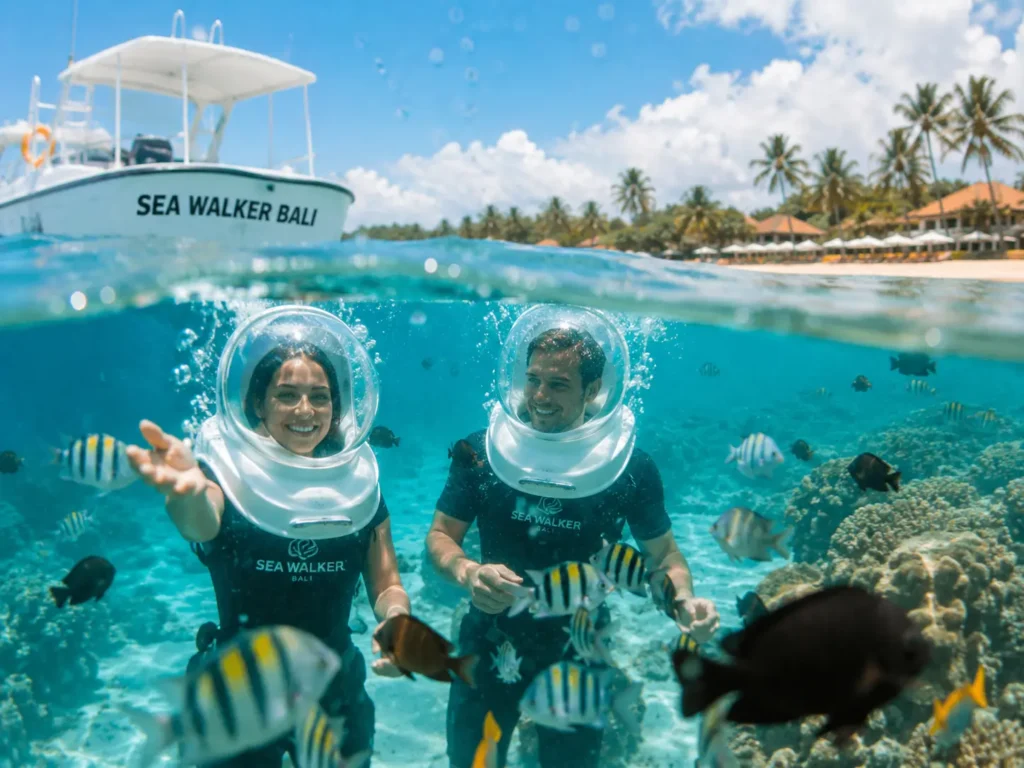
SEA WALKER BALI
Explore This Guide
Jump directly to the information you need.
Choosing the Right Sea Walker Experience
Sea Walker suits visitors who want to experience being underwater without learning to scuba dive or relying on swimming ability. The important differences between products are the actual underwater minutes, location, age and health rules, supervision, facilities, transfers and final price.
Most experiences require considerably more total time than the advertised underwater walk itself.
Sea Walker Bali Quick Facts
| Practical detail | What to expect |
|---|---|
| Main location | Tanjung Benoa, beside the Nusa Dua resort area |
| Other options | Selected Sanur and other specialist Bali Sea Walker products |
| Activity type | Walking underwater with a surface-supplied air helmet |
| Swimming required | Usually no, but participants should be comfortable entering the water |
| Diving certification | Not required for standard Sea Walker experiences |
| Common underwater time | Approximately 10–30 minutes depending on product |
| Typical online price | Approximately IDR 325,000–600,000 per person; premium or transfer packages may cost more |
| Typical depth | Usually only several metres, commonly around 3–5 metres |
| Minimum age | Operator-specific; commonly around 8–10 years or older |
| Total time to allow | Usually around 45–90 minutes locally; longer with transfers or additional activities |
| Best general time | Morning is usually the most practical period |
| Glasses | Prescription glasses and contact lenses are normally possible inside the helmet |
Which Sea Walker Option Is Right for You?
| If you want... | Start with... |
|---|---|
| The widest choice and easy watersport combinations | Tanjung Benoa — the main Sea Walker centre |
| A Sea Walker option convenient from Bali's south-east coast | Sanur — confirm current product availability and inclusions |
| Sea Walker as the main activity | A standalone Sea Walker session — compare actual underwater minutes |
| Several short water activities in one visit | A Tanjung Benoa combination package — check the duration of every activity |
Is Sea Walker Bali Worth It?
Sea Walker is worth considering when you want the sensation of being underwater without committing to scuba-diving training.
Its main appeal is accessibility. You descend with an instructor, breathe normally inside the helmet and walk along a controlled underwater route rather than swimming independently.
It is particularly suitable when:
- You are not a scuba diver: no existing diving certification is normally required.
- You are not a strong swimmer: most Sea Walker products do not rely on independent swimming.
- You want a short underwater experience: it requires far less commitment than a full diving day.
- You want to keep prescription glasses on: this is normally possible inside the air-filled helmet.
- You are already visiting Tanjung Benoa: Sea Walker combines easily with other watersports in the same area.
It may be better to choose another activity when:
- You want a long underwater experience: actual seabed time is usually measured in minutes rather than hours.
- You dislike enclosed equipment: the large helmet can feel unusual even though your face remains in air.
- You have difficulty equalising your ears: water pressure still changes as you descend.
- You want maximum freedom underwater: the route is controlled and an instructor remains with the group.
- Your main priority is reef exploration: dedicated snorkelling or diving trips may provide a broader marine experience.
How Sea Walker Works
“Sea Walker”, “seawalker”, “sea walking”, “ocean walker” and “helmet diving” can describe broadly similar experiences, but individual products are not identical.
What Actually Happens During Sea Walker?
You are briefed on land or at the activity centre, transferred to the Sea Walker entry point, fitted with the helmet and guided down to a shallow underwater walking area.
The exact procedure varies, but a standard experience normally involves:
- Registration: staff check your booking and may ask about age and health conditions.
- Safety briefing: you learn underwater hand signals, how to descend and what to do if you feel uncomfortable.
- Boat or platform transfer: many Tanjung Benoa products use a short boat journey to an offshore activity point.
- Helmet fitting: the air-supplied helmet is placed over your head as you enter the water.
- Controlled descent: you descend gradually while managing the pressure in your ears.
- Underwater walk: an instructor stays with the group while you walk through the designated area.
- Return: you ascend, remove the equipment and return to the activity centre.
You do not carry a scuba cylinder or breathe through a regulator. Air is supplied continuously from the surface to the helmet.
What Does the Sea Walker Helmet Feel Like?
The helmet keeps an air space around your face, allowing you to breathe normally without holding a mouthpiece or regulator.
The helmet is supplied continuously with air from the surface. Water remains below the helmet's internal air space while you are upright, so you can normally breathe through your nose and mouth as you would on land.
The experience can still feel unusual because the helmet rests around the shoulders and the surrounding water creates pressure as you descend. You also communicate mainly through hand signals rather than speech.
Your body will be wet even though your face is inside the helmet. Keep your head upright and follow the instructor's directions rather than experimenting with the equipment.
Do Your Ears Feel Pressure Underwater?
Yes. Sea Walker takes place only a few metres underwater, but pressure still increases during descent and your ears must adjust.
The briefing should explain how to manage ear pressure and how to tell the guide when you need to stop or move more slowly.
- Descend gradually: do not rush down the entry ladder or platform.
- Signal early: tell the guide immediately if you feel increasing ear discomfort.
- Never force through pain: returning shallower is more sensible than continuing an uncomfortable descent.
- Disclose congestion: a cold, blocked sinuses or a recent ear problem can make equalising difficult.
If you already know that you cannot equalise your ears comfortably underwater, Sea Walker may not be an appropriate activity for you.
Best Sea Walker Locations in Bali
Tanjung Benoa is the most practical choice for most visitors because it has the widest concentration of Sea Walker and other watersports products.
| Location | Best for | Main consideration |
|---|---|---|
| Tanjung Benoa | First-timers, watersport combinations and South Bali visitors | Busy activity centre; products and underwater time vary |
| Sanur | Visitors staying on Bali's south-east coast | Fewer products; compare current availability and inclusions |
| Nusa Dua listings | Visitors staying in the resort area | Many products labelled “Nusa Dua” actually operate from nearby Tanjung Benoa |
Always confirm the exact meeting point. “Nusa Dua”, “Benoa” and “Tanjung Benoa” are sometimes used loosely in activity listings.
MAIN SOUTH BALI SEA WALKER AREA
Tanjung Benoa
Tanjung Benoa is Bali's principal watersports centre and the easiest place to compare Sea Walker with Jet Ski, parasailing, banana boat and other short activities. Operators commonly use offshore pontoons or designated underwater areas reached by boat.
SOUTH-EAST BALI OPTION
Sanur
Sanur has also been associated with dedicated Sea Walker experiences. It can be more convenient when you are already staying in Sanur, but current product availability, underwater duration and transfer arrangements should be checked rather than assumed.
Planning Your Sea Walker Experience
Plan around the actual underwater minutes, total visit time, participant requirements, facilities and transport rather than the headline package duration.
How Much Does Sea Walker Bali Cost?
A realistic online price for a standalone Sea Walker experience is approximately IDR 325,000–600,000 per person, although transfer and premium packages may cost more.
Current published Tanjung Benoa products demonstrate why one fixed Sea Walker price is misleading. Some sell a short underwater session separately, while others include longer underwater time, transfers or additional watersports.
| Product | What changes the value |
|---|---|
| Short Sea Walker session | Actual underwater minutes and whether boat transfer is included |
| Longer Sea Walker session | More underwater time rather than simply more waiting time |
| Sea Walker with hotel transfer | Pickup area, private or shared transport and return coverage |
| Watersports combination | Duration of every individual activity and waiting between them |
| Premium package | Facilities, photos or video, transport, meals and other inclusions |
Before paying, confirm whether the price includes:
- Actual underwater time: not merely the total duration shown on the booking page.
- Equipment: helmet, underwater footwear and other required gear.
- Supervision: instructor or guide throughout the underwater section.
- Boat transfer: when the underwater site is offshore.
- Facilities: locker, shower, changing room and towel where applicable.
- Insurance: confirm exactly what activity coverage is included.
- Photos or video: these are often sold separately.
- Hotel transport: never assume it is included from every area.
How Much Time Should You Plan for Sea Walker?
Allow roughly 45–90 minutes for a straightforward local Sea Walker experience, even though the actual underwater walk may last only 10–30 minutes.
Total time normally includes registration, changing, briefing, equipment preparation, boat or pontoon transfer, waiting, the underwater session and returning to shore.
- About 45–60 minutes: a well-organised short session without hotel transport.
- About 60–90 minutes: a normal visit with preparation, transfer to the underwater point and some waiting.
- Two to three hours: Sea Walker combined with several other watersports.
- Half a day or longer: hotel transfers, lunch or sightseeing added to the activity.
Ask specifically for the underwater walking time. A two-hour booking does not mean two hours beneath the surface.
When Is the Best Time to Go?
Morning is usually the most practical time for Sea Walker because conditions are often calmer and you have more flexibility if the schedule changes.
Around 09:00–11:00 is a sensible general target, but tides, wind, visibility, rain and local boat activity can affect the experience on any day.
- Earlier sessions: often provide lower heat and more time to reschedule if conditions change.
- Later sessions: can still operate, but wind and marine traffic may increase.
- Light rain: does not automatically make Sea Walker impossible.
- Unsafe conditions: strong wind, thunderstorms, poor visibility or unsuitable sea conditions should delay or stop the activity.
Do not judge conditions only from the weather at your hotel. The operator should make the final decision at the actual activity site.
What Should You Wear and Bring?
Wear swimwear and bring dry clothes; the operator supplies the specialist Sea Walker equipment.
Useful items include:
- Swimwear: wear it beneath your clothes to simplify changing.
- Towel: some products include one, but do not assume this.
- Dry clothes: useful after returning from the water.
- Secure footwear: sandals or flip-flops are practical around the activity centre.
- Sun protection: especially when waiting on the beach or boat.
- Booking confirmation: keep the meeting-point information accessible.
- Payment method: useful for photographs, extra activities or other optional costs.
Avoid taking unnecessary jewellery, passports or expensive electronics onto the activity platform. Use a secure locker when one is available.
What Facilities Are Usually Available?
Larger Tanjung Benoa operators usually provide basic changing and storage facilities, but the standard and inclusions vary.
- Changing facilities: toilets, changing rooms and showers are common at established centres.
- Lockers: often available, but confirm whether they are included or charged separately.
- Towels: included with some products and absent from others.
- Waiting areas: larger centres may provide covered seating.
- Photos and video: commonly offered as an optional extra.
- Hotel transfers: available with selected products and pickup zones.
Facilities are secondary to the condition of the equipment, quality of the briefing and level of underwater supervision.
Should You Book Sea Walker Bali in Advance?
Advance booking is sensible when you need transport, have children in the group, require confirmation of a health condition or want a specific underwater duration.
- Groups and families: booking ahead gives the operator time to confirm age and equipment requirements.
- Fixed schedules: pre-book when another tour or transfer depends on your finishing time.
- Hotel pickup: confirm the covered area, pickup time and whether the transfer is private or shared.
- Longer sessions: obtain written confirmation of the actual underwater minutes.
- Busy periods: advance booking gives more choice of time and package.
Walk-in bookings may be possible in Tanjung Benoa, but it becomes harder to compare several products carefully once you are already at an activity counter.
Keep the written booking description. It should show the meeting point, activity duration, participant rules, inclusions and final price.
Are Sea Walker Combination Packages Better Value?
A combination package makes sense when you genuinely want several short Tanjung Benoa activities; it is not automatically better value than booking Sea Walker alone.
Common combinations include Jet Ski, parasailing, banana boat, flying fish, snorkelling and other watersports.
| Check | Why it matters |
|---|---|
| Sea Walker underwater time | A package may include only the shortest version |
| Other activity durations | Some watersports last only a few minutes or one round |
| Waiting time | Several short activities can still occupy hours |
| Weather rules | One activity may stop while the others continue |
| Transfer coverage | Pickup may apply only to certain accommodation areas |
| Refund conditions | A cancelled activity may not automatically produce a proportional refund |
Choose Sea Walker alone when the underwater experience is your main priority. Choose a package when you would have booked the additional watersports anyway.
Can Sea Walker Be Combined with Sightseeing?
Yes. Tanjung Benoa Sea Walker fits most naturally into a South Bali day rather than an itinerary that crosses the whole island.
Sea Walker and Nusa Dua
This is the simplest combination. Complete Sea Walker in the morning, then continue to a Nusa Dua beach, lunch or another nearby stop without spending much of the day in traffic.
Sea Walker and Uluwatu
A morning activity can be followed by the southern peninsula, beaches, Uluwatu Temple and an evening Kecak performance. Private transport is useful because the stops are spread out.
Sea Walker and Other Watersports
Combining activities at one Tanjung Benoa centre minimises additional transport and changing time. Two or three carefully chosen activities are usually easier to enjoy than trying to complete every available watersport.
Avoid building a short Sea Walker session into an already crowded North Bali or distant inland itinerary merely because the activity itself appears brief.
Safety & Suitability
Sea Walker is designed for beginners and many non-swimmers, but comfort underwater, ear pressure, age, health screening and continuous supervision still matter.
Is Sea Walker Suitable for Beginners and Non-Swimmers?
Yes. Sea Walker is specifically designed to make a shallow underwater experience accessible without previous diving experience, and many operators accept non-swimmers.
You do not need to operate scuba equipment or swim through the water. You descend using the operator's entry system and remain with an underwater guide.
However, “non-swimmer friendly” does not mean that comfort around water is irrelevant.
- Tell the operator: inform staff before entering if you cannot swim.
- Follow the briefing: you need to understand the guide's underwater signals.
- Stay calm: the helmet, water pressure and underwater environment can feel unfamiliar at first.
- Stop if uncomfortable: do not continue simply because the activity is marketed to beginners.
Someone who is likely to panic when descending underwater should discuss this honestly with the operator before paying.
Is Sea Walker Bali Safe?
Sea Walker can be a manageable beginner activity when the operator uses suitable equipment, provides proper supervision and screens participants appropriately.
A basic safety standard should include:
- Clear briefing: you understand the descent, hand signals and what to do if uncomfortable.
- Continuous supervision: an instructor or underwater guide remains with participants.
- Suitable equipment: the helmet and other equipment are correctly fitted and maintained.
- Controlled descent: participants are not hurried when adjusting to pressure.
- Weather judgement: unsafe sea conditions should result in delay, rescheduling or cancellation.
- Health screening: relevant medical conditions are considered before entering the water.
Do not participate if staff dismiss obvious discomfort, cannot explain the safety procedure or pressure you to continue after you ask to stop.
Who Should Check Before Participating?
Health restrictions vary by operator, so disclose relevant conditions before booking rather than waiting until check-in.
Sea Walker operators and booking products commonly apply restrictions or request additional assessment for participants with conditions such as:
- Pregnancy: many underwater activity providers do not accept pregnant participants.
- Heart conditions: serious cardiovascular conditions may prevent participation.
- Respiratory conditions: disclose asthma or other significant breathing problems.
- Ear or sinus problems: active congestion or a recent ear infection can affect pressure equalisation.
- Significant back or mobility problems: the entry, ladder and underwater movement may be unsuitable.
- Claustrophobia or severe anxiety: the helmet and underwater environment may be uncomfortable.
This is not a universal medical checklist. The chosen operator's eligibility rules apply to the specific activity. When a medical condition makes suitability uncertain, obtain appropriate medical advice before participating.
Is Sea Walker Suitable for Children?
Sea Walker can suit older children, but there is no single minimum age used by every Bali operator.
Current published products use minimum ages from roughly eight or nine years upwards, while some operators apply higher limits. The final decision can also depend on the child's size, helmet fit, ability to understand instructions and comfort underwater.
- Confirm the exact age rule: do not rely on a general claim that Sea Walker is “family friendly”.
- Ask about helmet fit: equipment must sit correctly on a smaller participant.
- Consider confidence: the child should genuinely want to descend underwater.
- Check health restrictions: the same pressure and medical considerations still apply.
- Check insurance: confirm that the child's participation is included in the stated coverage.
A minimum age alone does not make the experience suitable. A child who becomes distressed by the helmet or cannot manage ear pressure should not be pushed to continue.
Can You Wear Glasses or Contact Lenses?
Yes. Prescription glasses can normally be worn inside a Sea Walker helmet because your face remains in an air space rather than behind a tight diving mask.
Contact lenses are also normally possible, although glasses may be the more comfortable option if you are concerned about unexpected splashing.
Very large frames or unusual eyewear should be mentioned before the activity so the operator can confirm that the helmet can be used comfortably.
Do not confuse Sea Walker with snorkelling or scuba diving. Standard swim goggles and ordinary diving masks have completely different fit and pressure considerations.
How Do You Choose a Reliable Sea Walker Operator?
Choose the operator by product clarity, participant screening and supervision rather than by the largest advertised discount.
Before paying, obtain clear answers to these questions:
- Where exactly is check-in? Save the actual activity-centre location.
- How many minutes are underwater? Separate this from total booking duration.
- What is the minimum age? Confirm the rule for every child in your group.
- What health restrictions apply? Ask before paying when there is any relevant condition.
- Who accompanies you underwater? Continuous guide supervision should be clear.
- What is included? Equipment, boat, locker, shower, towel, insurance, photos and transfer should be itemised.
- What happens in bad weather? Ask about delay, rescheduling and refund conditions.
- Are photographs extra? Do not assume underwater images are included.
Be cautious when the seller cannot state the actual underwater duration or says that every participant can join without asking about age or relevant health conditions.
Frequently Asked Questions
Is Sea Walker the same as scuba diving?
No. Both take place underwater, but Sea Walker uses a surface-supplied helmet and a controlled walking route. Scuba diving uses self-contained breathing equipment and requires different training, skills and medical considerations.
Can you talk inside the helmet?
Normal conversation with the guide is not practical underwater. Operators use simple hand signals to communicate whether you are comfortable or need assistance.
Will your face and hair stay dry?
Your face normally remains in the air space inside the helmet. Hair kept inside the helmet may remain largely dry, but splashing during entry or exit is possible and your body will be in the water.
Are underwater photographs included?
Not necessarily. Some operators photograph or film participants and sell the files afterwards, while selected packages include them. Confirm this before booking if photographs matter to you.
Will you definitely see lots of fish or coral?
No. Water clarity, fish movement and underwater conditions vary naturally. Treat wildlife and visibility as part of the environment rather than a guaranteed booking inclusion.
Related Experiences
The best alternative depends on whether you want easier marine viewing, a fuller underwater experience or a completely different type of watersport.
Choose snorkeling when you are comfortable swimming and want more freedom to observe reefs and marine life from the surface.
Choose scuba diving when you want a more complete underwater experience and are willing to learn the required skills.
Choose Jet Skiing when speed and a short surface-based adrenaline activity matter more than underwater exploration.
Final Advice
Choose Tanjung Benoa when convenience, beginner accessibility and the option to combine several watersports matter most.
Before paying, confirm the actual underwater minutes, exact location, minimum age, relevant health rules, supervision, facilities, insurance, transport and complete price. If ear pressure, anxiety or the helmet feels wrong during the descent, signal the guide and stop rather than forcing yourself to continue.
Explore the Best Bali 4 U Network
These connected guides and planning resources are useful next steps after deciding whether Sea Walker suits your Bali plans.
Questions About This Guide?
Contact the editorial team if you have a question about this guide, have noticed information that should be corrected or updated, or would like to share reliable local knowledge, suggestions or feedback.